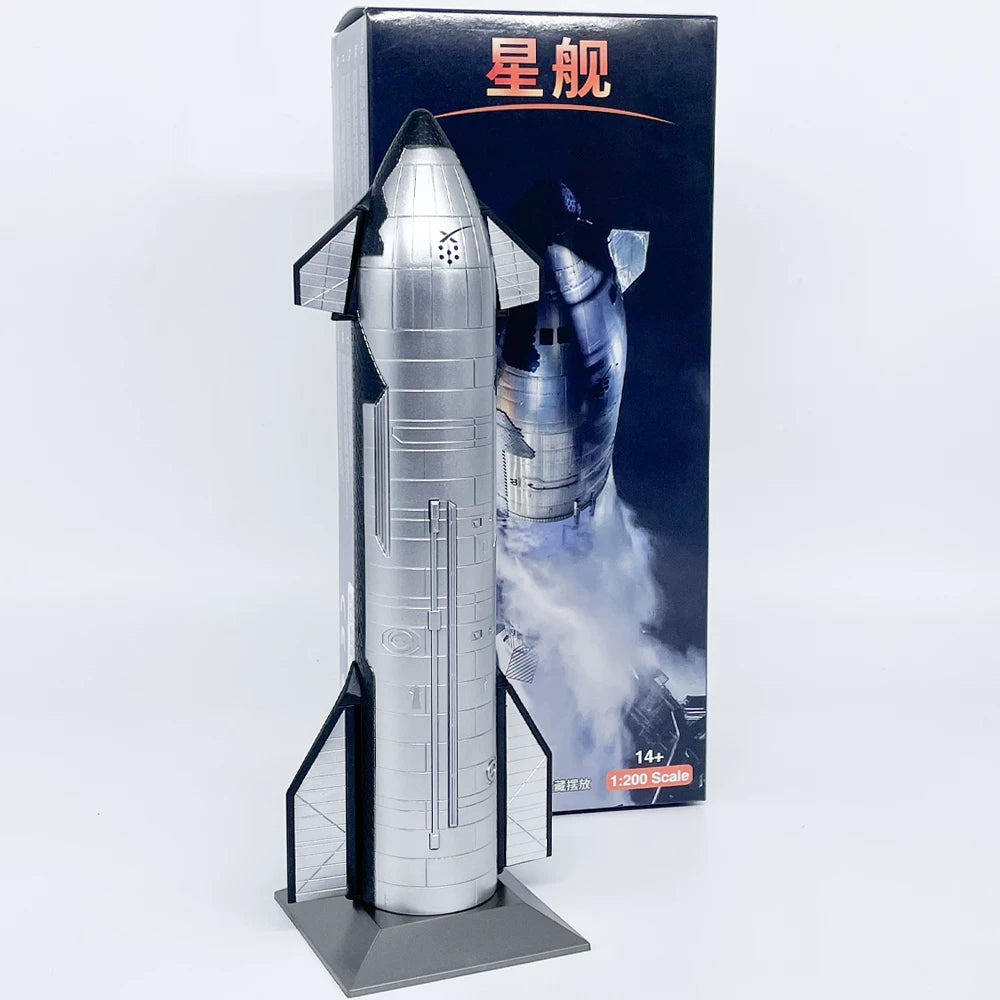
- diecast and pre-painted, ready to display
- material: metal & plastic
- scale: 1/200
- sizes:
- Falcon 9 Launch: 10.5*6.7*29.5 cm;
- Falcon 9 Recover: 5.8*5.8*21.8 cm;
- 1/200 scale Starship spacecraft: 9.2*5*25 cm
Falcon 9 is a partially reusable, two-stage-to-orbit, medium-lift launch vehicle designed and manufactured in the United States by SpaceX. The first Falcon 9 launch was on June 4, 2010, and the first commercial resupply mission to the International Space Station (ISS) launched on October 8, 2012. In 2020, it became the first commercial rocket to launch humans to orbit. The Falcon 9 has been noted for its reliability and high launch cadence, with 579 successful launches, two in-flight failures, one partial failure and one pre-flight destruction.
The rocket has two stages. The first (booster) stage carries the second stage and payload to a predetermined speed and altitude, after which the second stage accelerates the payload to its target orbit. The booster is capable of landing vertically to facilitate reuse, while the fairing halves are scooped out of water after a parachute-assisted landing. This feat was first achieved on flight 20 in December 2015. As of December 17, 2025, SpaceX has successfully landed Falcon 9 boosters 537 times. Individual boosters have flown as many as 31 flights. Both stages are powered by SpaceX Merlin engines, using cryogenic liquid oxygen and rocket-grade kerosene (RP-1) as propellants. On the other hand, both active halves are recovered and reflown multiple times with first occurrence being, March 30, 2017, thereafter individual fairing halves having flown as many as 36 flights.
The heaviest payloads flown to geostationary transfer orbit (GTO) were Intelsat 35e carrying 6,761 kg (14,905 lb), and Telstar 19V with 7,075 kg (15,598 lb). The former was launched into an advantageous super-synchronous transfer orbit, while the latter went into a lower-energy GTO, with an apogee well below the geostationary altitude. On January 24, 2021, Falcon 9 set a record for the most satellites launched by a single rocket, carrying 143 into orbit.
Falcon 9 is human-rated for transporting NASA astronauts to the ISS, certified for the National Security Space Launch program and the NASA Launch Services Program lists it as a "Category 3" (Low Risk) launch vehicle allowing it to launch the agency's most expensive, important, and complex missions.
Several versions of Falcon 9 have been built and flown: v1.0 flew from 2010 to 2013, v1.1 flew from 2013 to 2016, while v1.2 Full Thrust first launched in 2015, encompassing the Block 5 variant, which has been in operation since May 2018.
--copied from Wikipedia